Best practice case studies from around the world that have used district cooling systems for space cooling have been described below with details relating to technical specifications, cost and energy savings and payback period.
| Location | Zaragosa, Spain |
|---|---|
| Climate zone | Mediterranean-continental (cool winters-hot summers) |
| Product type | The use of a 4.3 MW and 7 MW gas engine CHP units, in conjunction with a 6 MW biomass boiler and 4 MW gas boiler. For cooling, two compression chillers (2 x 9 MW) and two absorption chillers (1 MW and 6 MW) to provide district heating and cooling to 5 000 residential dwellings, a 500 bed hospital and a hotel. |
| Key components | The gas engine runs continuously to meet hot water and cooling needs. An important part of the economics is the ability to sell surplus electricity to the wholesale market during winter |
Short description of the solution
The analysis presented looks at the economics of using CHP units to meet the space and water heating and cooling needs of 5,000 residential dwellings, a 500 bed hospital and a hotel via a district heating and cooling network in Zaragosa, Spain.
Basic information
Demand profiles for the residential sector and the hotel were taken from real data collected by the University of Zaragosa. The hospital is the Miguel Servet Hospital with a capacity of 500 beds. The demand profiles for the hotel were based on a hotel in Gerona, which has a similar climate, where actual measurements have been taken. The hotel has a total surface of 16,382 m2 in eight floors and it consists of 386 bedrooms. The school considered is situated in a building of three floors and a total surface of 1,200 m2. The school has a total surface area of 1,200 m2 spread over 20 classrooms and serves approximately 600 pupils. The heating and cooling demands for the school were not based on real measurements, but simulated. The combined heating, cooling and electricity demands for each of the end-users are presented in the following figures.
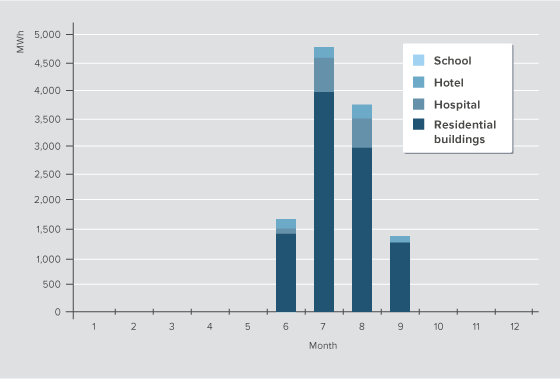
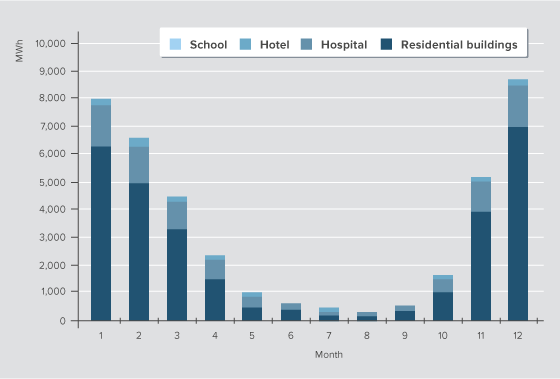
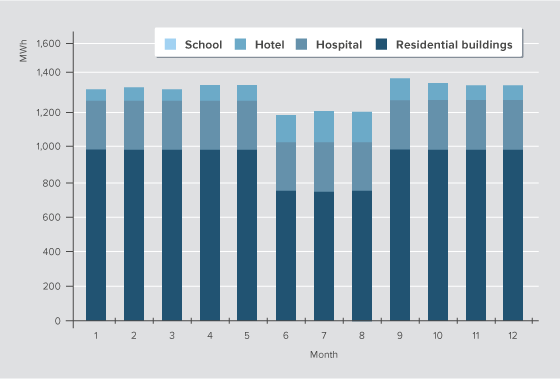
The analysis identified that the most economic configuration for the system was the use of one 4.3 MW gas engine CHP system and one 7 MW gas engine CHP system in conjunction with two compression chillers (2 x 9 MW) and two absorption chillers (1 MW and 6 MW). The smaller gas engine CHP system would run more or less continually to meet hot water and cooling needs and a portion of space heating needs. The economics of the other CHP unit are driven by the ability to sell surplus electricity to the wholesale market. As a result, all of the heat needed and almost all of the electricity to meet the demands of the three end-users, as well as to drive the compression chillers and absorption chillers are provided by the two CHP systems. The absorption machines provide the baseload to meet the cooling demand, while the compression chillers are brought online as cooling demand rises.
Energy and cost performance
The energy and economic performance of the modelled trigeneration system is summarised in the following table. Initial investment costs are significantly higher due to the costs of the absorption chillers and district cooling piping. However, the project has a payback period of 10 years for the equipment.
| Item | Energy and economic performance |
|---|---|
| Electrical efficiency | 41% |
| Thermal efficiency | 40% |
| Total efficiency (net) | 81% |
| COP of the compression chillers | 5.3 |
| COP of absorption chillers | 0.7 |
| Total investment costs (€) | 16,152,754 |
| Compression chillers (€/kW) | 200 |
| Absorption chillers (€/kW) | 320 |
| Heating provided (MWh) | 39,100 |
| Cooling provided (MWh) | 11,600 |
| Electricity demand (MWh) | 15,700 |
| Total fuel consumption (MWh) | 127,180 |
| Gas engine CHP 1 (MWh) | 61,500 |
| Gas engine CHP 2 (MWh) | 54,600 |
| Gas boiler (MWh) | 4,300 |
| Biomass boiler (MWh) | 6,780 |
| Fuel costs (per annum) (€) | 4,006,145 |
| Electricity revenue (per annum) (€) | 2,531,950 |
| Location | Shanghai Pudong International Airport, China |
|---|---|
| Climate zone | Hot humid |
| Product type: | Centaur 50 gas turbine supplied by Solar Turbines, an unfired Heat Recovery Steam Generator (HRSG) and steam-fired absorption chillers. The electrical capacity is 4.6 MW. |
| Key components | Heat recovery steam generator, producing 11 tonnes / hour at 8 bar, 185ºC with absorption chillers |
Short description of the solution
The CHCP plant at Shanghai Pudong International Airport generates electricity, heating and cooling for the airport’s terminals at peak demand times, with traditional heating and cooling solutions to meet the balance of demand. Gas turbines totalling 4.6 MW of electrical capacity run for an average of 16 hours a day on natural gas. The HRSG takes the gas engine exhaust at the rate of 11 tonnes/hour to produce saturated steam at 8 bar and 185 ºC. The steam is used by the absorption chillers to cool water to 7 ºC/12 ºC. Although the project is connected to the electricity network at a 10.5 kV level the project does not export electricity (electricity demand is around six times the CHCP capacity). The system is not designed to meet all electrical, heat and cooling loads, rather to reduce energy costs at peak times. It therefore not only helps to improve reliability and security of supply, but also to reduce overall energy costs.
Basic information
The CCHP project at Shanghai airport became operational in 1999 and the system produces on average 19.2 GWh of energy per year. The system is quiet (<60dBA) and achieves very low local pollutant emissions and CO2 emissions compared to the average of electricity in China which is based predominantly on coal-fired generation. Maintenance requires less than 10 days per year, while unscheduled outages are less than five days per year.
Energy and cost performance
The energy and economic performance of the Shanghai Pudong International Airport CHCP system is summarised in the following table. Initial investment costs are significantly higher due to the costs of the electrical prime mover, HRSG and absorption chillers. However, this has to be balanced by the electricity savings achieved from self-generation.
| Item | Energy and economic performance |
|---|---|
| Electrical efficiency | 26% |
| Thermal efficiency | 45% |
| Total efficiency | 74% |
| Efficiency of separate electricity and heat provision | 55% |
| Project Lifetime | 25 years |
| Total investment costs | USD 5,400/kW |
| Payback period | 6 years |
The project economics are solid and the energy savings of the system allow for a payback period of 6 years. This is relatively long, but for an organisation such as an airport with long-term planning horizons, it remains a very attractive investment. This is particularly true given that it insulates the owners from changes in peak electricity charges.
| Location | Kuwait City, Kuwait |
|---|---|
| Climate zone | Hot-dry |
| Product type | The use of a district cooling system to meet the needs of 466 houses, two mosques and a school at the Block 1 South Doha Residential Development. |
| Key components | Diversity of loads and timing allows total capacity to be 15% lower for the district cooling system, even after taking into account heat gains from pumps, air handling units, etc. |
Short description of the solution
The analysis presented here looks at the use of a district cooling system to meet the needs of 466 houses, two mosques and a school at the Block 1 South Doha Residential Development. The default solution would be conventional compression air conditioners of the individual packaged unit type of between 35 to 150 KW of cooling capacity with air cooled condensers. With summer time temperatures above 50°C, the efficiency of these units can fall to low levels, making district cooling and attractive solution.
Basic information
Demand profiles have been estimated and it is assumed that the diversity factor for loads will mean that the district cooling system would require 31% less capacity to meet peak loads, even after allowing for the heat gains from the chilled water pumps and piping. Total load hours to provide round the clock comfort are assumed to be 6 600 per year. Cooling production is only 1% more in the district cooling system than in a system with individual, distributed packaged air conditioners. The extra cooling required is due to the heat gains from the chilled water pumps and the in the chilled water piping. However, overall energy consumption for cooling of the conventional system is around 64.2 GWh, while for the district cooling system it is 21% less at 50.5 GWh.
The district cooling system would comprise 7 approximately 2.3 MW sized compression chillers to meet cooling needs (with an approximately 7% reserve margin), but would be complemented by an eighth unit in standby mode. Each of the eight chillers would have a condenser water pump, cooling tower, chilled water primary pump and all fittings, piping and controls necessary. An added complication for the district cooling system is the water consumption required. This is an issue in Kuwait, as fresh water is provided by desalination at some cost. This increases running costs of the system somewhat.
Energy and cost performance
The energy and economic performance of the modelled district cooling and conventional individual packaged air conditioner solutions are summarised in the following table. Initial investment costs are somewhat higher due to the costs of the absorption chillers and district cooling piping. Overall, the district cooling system has a simple payback of less than one year, as the modest incremental costs of the district cooling system and higher operations and maintenance costs are more than offset by the higher overall system efficiency and hence lower electricity costs. This is despite the fact that electricity costs for residential consumers are subsidised in Kuwait.
| Item | Conventional | District cooling |
|---|---|---|
| Cooling peak demand (kW) | 21,914 | 15,101 |
| Total cooling load hours | 6,600 | 6,600 |
| Chillers | 469 packaged A/C units | 8 x 2.3 MW units |
| Cost of cooling production system (€ million) | 1.142 | 1.256 |
| Cost of cooling distribution (€ million) | - | 0.725 |
| Cost of building connections (€ million) | - | 0.097 |
| Total cost (€ million) | 1.142 | 2.078 |
| Electricity cost (€cent) | 0.485 | 0.280 |
| Total fuel consumption (MWh) | 64,209 | 50,519 |
| Total fuel savings (MWh) | - | 13,690 |

makes energy efficiency in buildings and appliances transparent. For investors, policy-makers and actors involved in implementation and consultancy. Learn more ...




 Buildings Guide
  Policy Guide
  Appliances Guide
  India
India South Africa